
When an Urgent Message Demands Action: 3 Checks Before You Trust It
A bank alert, delivery notice, or sudden work request can feel real because it gives you no time to think. These three checks move the decision to a place you control.
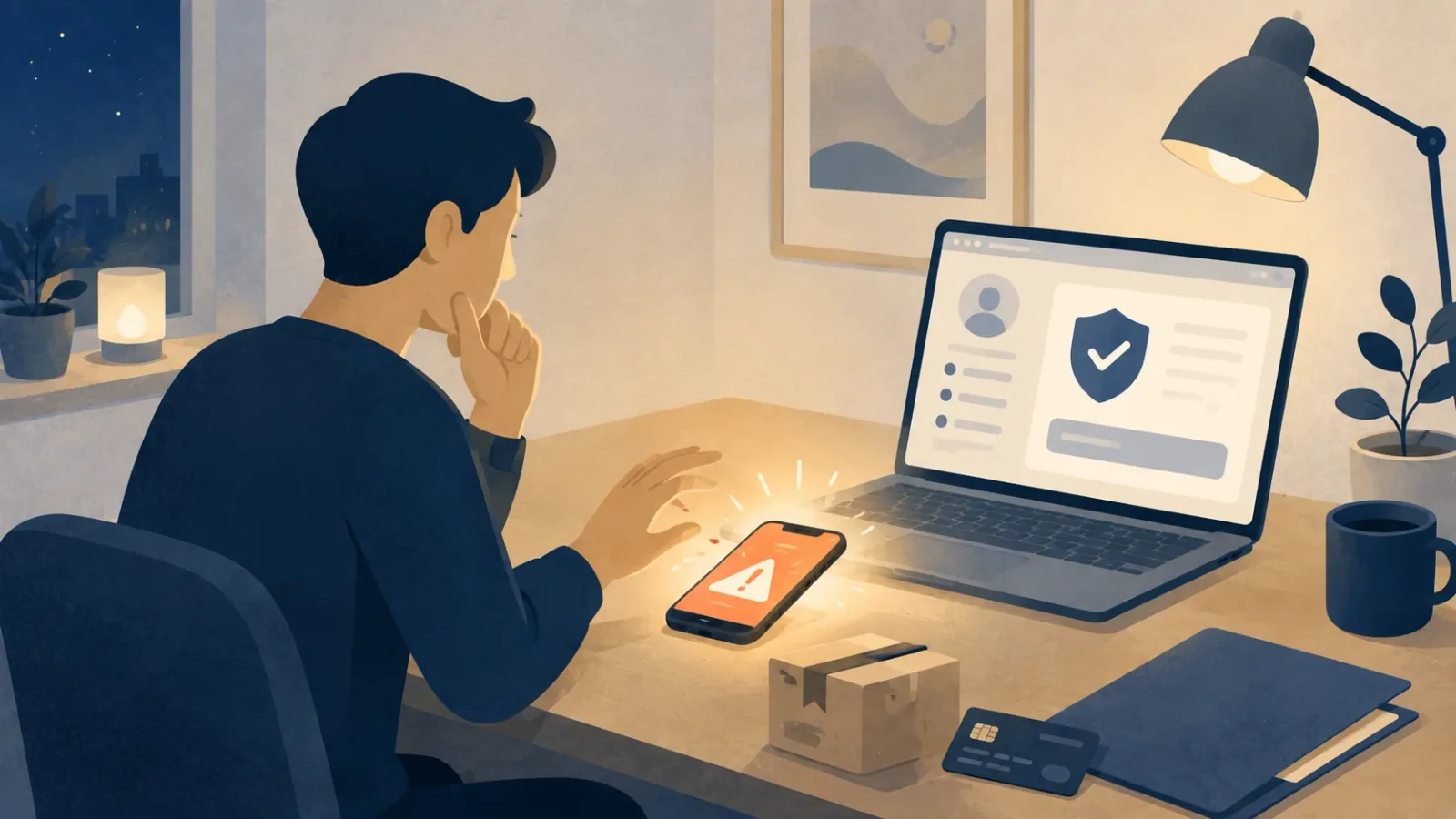
This article is for you if
You receive urgent messages about accounts, payments, deliveries, or work and want a simple way to check them before you act.
By the end, you will be able to
You will be able to recognise pressure, verify who is contacting you through a route you trust, and confirm whether the claimed problem is real before you click, pay, send information, or reply.
Your phone says it cannot wait. Do we have to let the message set the pace?
You may be on your way home in Lagos when a WhatsApp message appears: an account problem needs attention now, a payment has failed, or a parcel cannot be delivered.
A button or number is already there, making the next step look easy.
The pressure can make the message feel more trustworthy than it has earned.
So rather than trying to judge the whole message in a few seconds, we can move the decision somewhere else.
A safer way to respond
- Let’s separate the urgent story from the action it wants from us.
- Let’s check the sender through a route the message did not choose.
- Let’s confirm the claimed problem independently before we click, pay, send information, or reply.
1. Separate the pressure from the proof
An urgent message often gives you a frightening story and an immediate instruction.
The story might say, “Your account will be restricted.”
The instruction might say, “Verify now.”
Those are not the same thing.
Before deciding whether the story is true, ask:
What is this message trying to make me do quickly?
It may want you to open a link, send a verification code, share a card detail, make a payment, download a file, or call a number supplied in the message.
Phishing is a form of deception in which someone pretends to be trustworthy so that you reveal information or take an unsafe action. The U.S. Cybersecurity and Infrastructure Security Agency, or CISA, warns that urgent or emotional language and requests for personal or financial information can be signs of phishing. (CISA)
That warning does not mean every urgent message is fake.
A real bank can send an important alert. A real employer can need a fast answer. A real delivery can have a problem.
Urgency is therefore a reason to check differently, not proof of fraud.
The scale of impersonation scams shows why that pause can matter. The U.S. Federal Trade Commission reported in June 2026 that people reported losing $3.5 billion to imposter scams during 2025, and nearly one in three fraud reports received by the agency that year concerned imposter scams. Those figures describe reports to a U.S. agency, not all fraud in Nigeria or worldwide. (FTC)
An imposter scam is a scam in which someone pretends to be a person or organisation you may trust.
Imagine a message arriving while you are waiting for transport after work. It says your account will be blocked unless you act within ten minutes.
You do not have to prove that the warning is false before you pause.
You only have to see that the message is trying to turn its clock into your clock.
That is enough reason to stop using the route it prepared for you.
2. Check the sender through a route you already know
Now suppose a message claims to be from your bank or from someone you work with.
If you use the link, phone number, or reply button inside that same message to verify it, the message is still controlling the check.
You are asking the thing you doubt to prove itself.
A stronger check starts somewhere else.
CISA advises people who receive a suspicious message not to use its link, attachment, or phone number to verify it. Instead, its guidance recommends contacting the person or company through another route, such as a company website or a number you already know. (CISA)
The U.S. Federal Trade Commission gives similar advice for unexpected messages: contact the company through a phone number or website you know is real, or contact the person through a separate conversation. (FTC)
This gives us a practical rule:
Start verification from a place the suspicious message did not give you.
If the message claims to be from your bank, open the banking app you normally use or type the official website yourself.
If a work contact suddenly writes from a new WhatsApp number asking for an unusual file or payment, reach them through the work channel or number you already use.
If a company appears to be contacting you, use a saved account page, a familiar app, or contact details you found independently.
The difference is easy to picture:
Route chosen by the message: message → link → page chosen for you
Route chosen by you: message → pause → familiar app, official site, or known contact
You do not need to become an expert at judging logos, sender names, or writing styles.
You can make the message less powerful simply by changing the route before you decide what to believe.
3. Confirm that the problem exists outside the message
There is one more check after you reach a trusted channel.
Do not stop at, “Yes, this bank or company is real.”
Ask whether the event described in the message is real too.
Imagine that an online order is on its way and a text suddenly says there is a delivery problem. Instead of opening the link in the text, you open the order page or delivery route you normally use and look for the same problem there.
The same method applies to a supposed security alert or failed payment.
The FTC reported in 2026 that some of the costliest impersonation scams begin with fake security alerts, often pretending to come from banks. People can then be told to move money to “protect” it. (FTC)
So a trusted contact route has two jobs: it helps you check who is contacting you, and it gives you a separate place to check whether the claimed event actually happened.
| The message claims | Leave the message and use | What you are checking |
|---|---|---|
| Your account has a security problem | The normal account app or official site | Is there really an alert or restriction? |
| A parcel needs urgent action | The order page or delivery route you already trust | Is there really a problem with that parcel? |
| A colleague needs an unusual payment or file | Your normal work channel | Did that person actually make the request? |
| A payment failed | The service or account opened separately | Is there really an unpaid balance or failed payment? |
This changes the question from:
“Does this message look genuine?”
into:
“Can I find the same problem somewhere this message does not control?”
If the problem is real, you can continue through the verified route.
If there is no matching problem, the message no longer gets to choose your next move.
For suspected phishing, CISA recommends reporting the message and deleting it rather than following its links or attachments. (CISA)
The aim is not to identify every scam perfectly from appearance alone.
It is to move an important decision away from a place where an unknown sender controls the story, the urgency, and the next button.
Put the checks in this order
The three checks are strongest when they happen in sequence.
First, notice pressure so that speed does not become proof. Next, check identity through a route you chose. Then check reality by finding out whether the claimed account issue, payment, parcel problem, or work request actually exists.
None of the three can replace the others.
A calm message can still be false. A familiar name can still lead to a false page. A real organisation can exist even when the event described in the message does not.
So the whole method can fit into one line:
Separate the pressure → choose your own route → confirm the event.
You do not need to label every unexpected message as a scam.
You only need to keep an unverified message from controlling how you verify it.
Move closer to the person you want to become
- Let’s name the exact action an urgent message wants from us before we touch its link, button, or number.
- Let’s move to an app, website, phone number, or work channel we already trust.
- Let’s look for the same problem there before we send money, information, files, or a reply.
Coursera guide
If you want to understand the ideas behind these checks, structured cybersecurity learning can help you explore phishing, account protection, sign-in security, networks, and other parts of digital safety in a clear order.
You do not need a course to use the method in this article. Structured learning becomes useful when you want a deeper foundation and a guided path through the subject.
Continue reading
← Previous: [Same-country, same-language previous article]
Next: [Same-country, same-language next article] →
 Interrupted Mid-Task? Leave a Ready-to-Resume Note Before You Switch
 You Have Sent It. Now What? 3 Ways to Stop Waiting Like You Still Have Work to Do
 Do You Really Have Nothing You Want to Do—or Are You Rejecting Interests Too Early?