
Made a Mistake at Work? Find the Exact Skill Gap Before You Start Learning
Trace the mistake back to the point where the result changed, replay that moment, and learn only what would have made a difference.
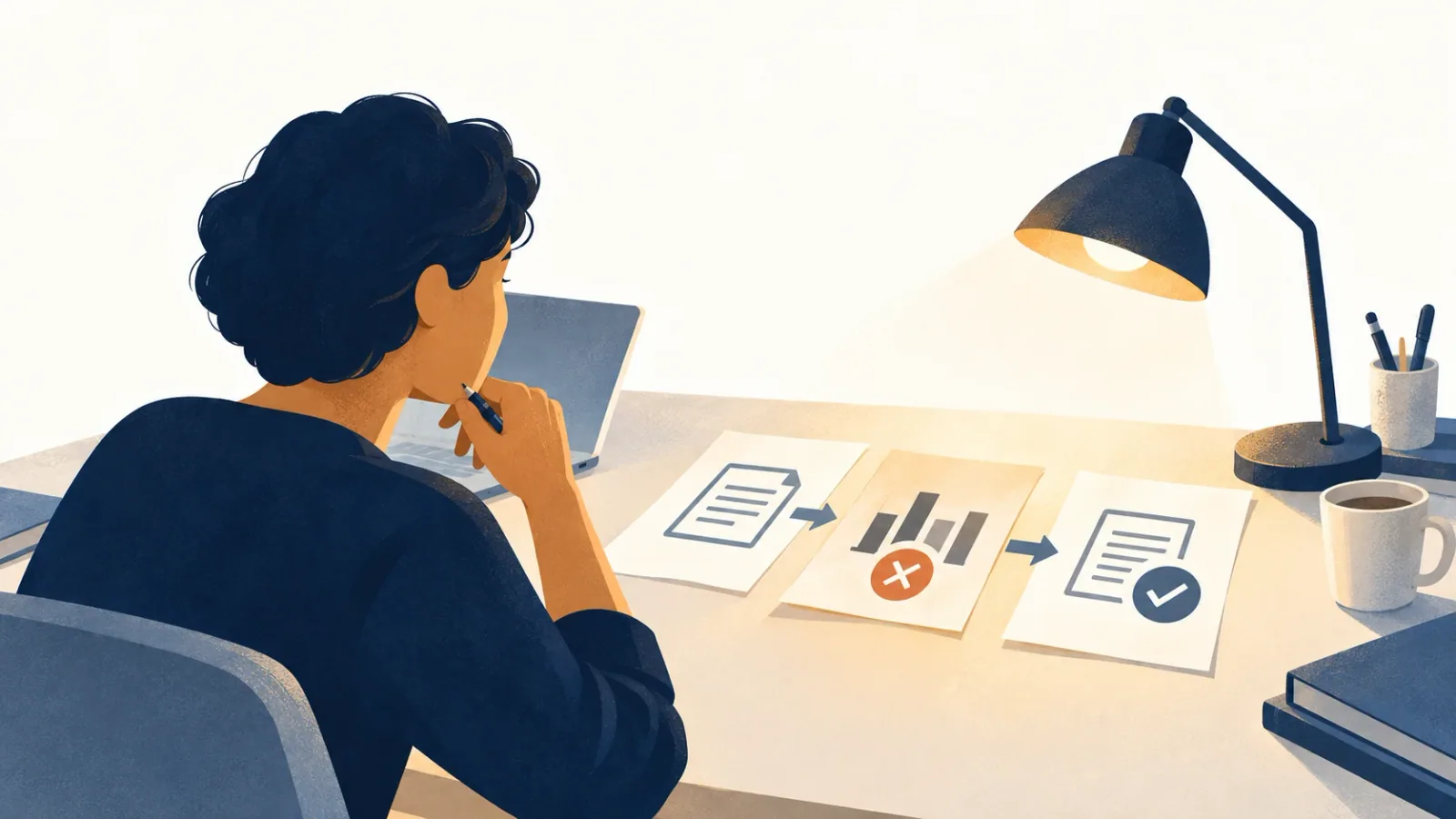
This article is for you if
You made a mistake at work and want to improve, but several possible weaknesses now seem equally important.
By the end, you will be able to
You can trace one mistake to the moment that needs attention, test whether the gap is knowledge, practice or process, and name one useful skill to learn.
One corrected file can make you question much more than that one file. Can we separate the mistake from the bigger judgement?
Imagine opening your laptop and seeing a weekly report that has been returned for correction.
The figures came from the wrong date range. Someone else noticed the problem. Now the same file is open again in front of you.
One mistake can quickly turn into several bigger conclusions.
Maybe your spreadsheet skills are weak. Maybe you are not careful enough. Maybe communication is the real issue.
But one mistake cannot prove all of those things.
It can only show you one place worth examining.
Instead of asking:
“What am I bad at?”
ask:
“At what exact moment would a different ability or action have changed the result?”
Let’s make the problem smaller before we make the learning bigger.
- Let’s find the point where the task could still have gone differently.
- Let’s replay that point to see whether a skill is truly missing.
- Let’s name one ability that would change that moment and test it on similar work.
1. Find the last moment when a different action could still have changed the result
The final error is usually easy to see.
The useful point to fix may be a few steps earlier.
Take the weekly report.
Saying “I am bad at reports” turns one mistake into a broad judgement.
Saying “I am careless” still does not tell you what action needs to change.
Instead, rebuild only the steps that mattered:
Opened the previous report → updated the figures → exported the file → sent it.
Then ask:
Where was the last moment when another action could still have prevented the error?
Perhaps it was just before export. The date range was visible, but it was not checked.
That is the decision point.
Here, a “decision point” simply means a small moment where the task could go in two directions. You could check the date range, or continue without checking it.
Now consider a different work situation.
You start updating a customer list after receiving a short instruction. Later, you learn that your manager meant a different group of customers.
The most useful point may not be the time already spent editing the list.
It may be the first minute, when you noticed that the instruction could mean two things but started the work without asking.
The UK Health and Safety Executive focuses on safety incidents rather than ordinary office mistakes, so its material is not a rule for every workplace problem. Its training page does, however, make a useful point: understanding why something went wrong can involve looking at both people and the system around the work. (Health and Safety Executive)
For an everyday work mistake, the lesson can stay simple.
A broad label about yourself does not show you what to change.
A precise moment can.
2. Replay that moment before deciding that you need training
Finding the decision point does not prove that you need a new skill.
Now repeat that part of the task when the pressure is lower.
Return to the report example.
A similar file is open. There is no rush. You already know that the date range matters.
What happens when you perform that critical step again?
A simple three-way check can help:
| When you replay the failed moment | What may need attention |
|---|---|
| You do not know the correct action or why it matters. | Knowledge |
| You know what to do but cannot yet do it reliably on your own. | Practice |
| You can do it correctly, but the way the task is arranged makes the step easy to miss. | Process |
This is a practical sorting tool for this article. It is not an official model of workplace performance.
If you do not understand how the report’s date filter works, there may be something useful to learn.
If you understand it but cannot yet use it reliably without help, focused practice may be the better next step.
But if you can perform the check correctly whenever you remember it, another course may not solve the real problem.
A clear final check before sending the report may be more direct.
The same test helps with unclear instructions.
If you do not know how to turn an unclear request into a clear question, there may be a communication skill worth learning.
If you already know how to ask but begin the work before confirming the meaning, the process may need to change instead.
The mistake may look the same from the outside.
The useful response changes because the cause changes.
That is why replaying the moment comes before choosing what to learn.
3. Name the smallest ability that would change that moment
If the replay shows a real knowledge or practice gap, you can now name the skill.
Keep it close to the situation that failed.
“Get better at data” is too broad.
“Improve communication” is too broad.
“Be more careful” still does not tell you what to practise.
A useful skill statement connects one situation to one action.
For the report:
When I prepare a recurring report, I can confirm the source period and final date range before export without someone reminding me.
For the unclear instruction:
When a task has two reasonable meanings, I can explain what I think it means and ask for confirmation before I begin.
Now the learning has a clear boundary.
You can tell which lesson or practice belongs inside the goal and which does not.
You can also check whether the learning changed the problem.
Try another permitted example of the same kind of task and repeat the critical step. If you need to keep evidence, use a blank template or a recreated sample rather than private company information.
The goal is not to build a large portfolio.
The first question is smaller:
“Can I now handle the moment that caused the problem?”
If the answer is not yet yes, the test shows you what still needs work.
If the answer is yes, you have evidence that the learning matched the real gap.
That is more useful than simply promising yourself to “do better next time”.
The order keeps one mistake from sending you towards the wrong lesson
The three steps have different jobs.
First, find the moment where another action could still have changed the result.
Then replay that moment to see whether the problem is knowledge, practice or the way the task is arranged.
Only after that does choosing a skill make sense.
Sometimes structured learning will help.
Sometimes a checklist, a clearer handover or one earlier question will solve the problem more directly.
The goal is not to turn every mistake into another course.
It is to let one mistake lead to a more accurate next move.
Move closer to the person you want to become
- Let’s take one mistake and find the last moment when a different action could still have changed the result.
- Let’s replay that moment before deciding whether learning is actually what it needs.
- Let’s choose one small ability we can test on similar work, so the next step comes from evidence rather than embarrassment.
Coursera guide
If replaying the moment shows a real knowledge or practice gap, structured learning may help. Coursera can be one option if you find a course or programme whose outline matches the exact ability you identified and gives you a suitable way to practise it.
If the main problem is the way the work is arranged, a course may not be the most direct fix.
 How to Practise a New Skill at Work Without Using Live Work as Your Test
 Back at Work, and a Familiar Task Suddenly Feels Unfamiliar: What Should You Relearn First?
 Manager Stopped Giving You Important Work After a Mistake? How to Earn Back Responsibility