
How to Practise a New Skill at Work Without Using Live Work as Your Test
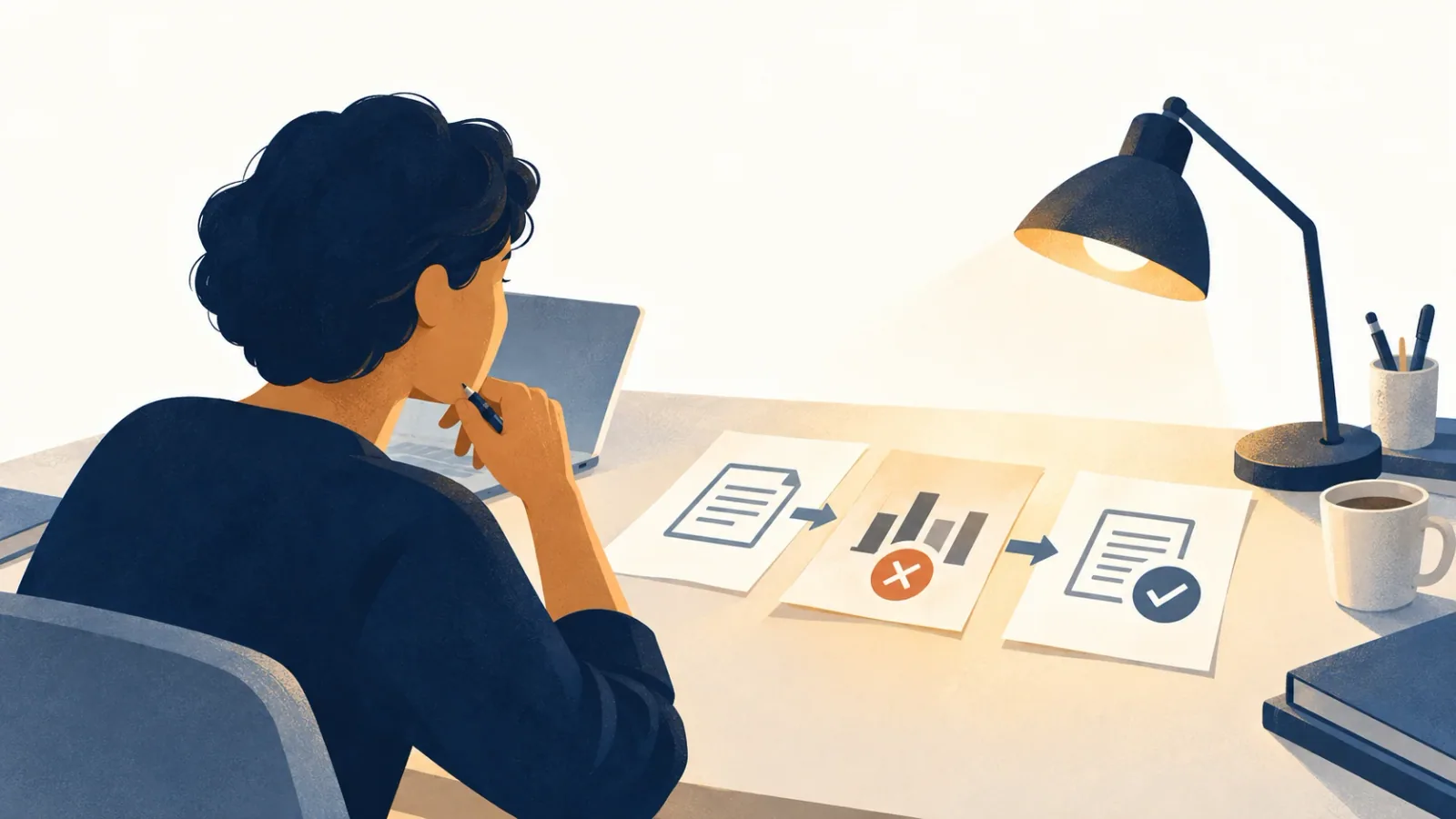
Build a practice ladder between a lesson and real responsibility: rehearse a non-live task, check it against a known standard, then use the skill on one protected real task.

This article is for you if
You understand a new skill in a lesson, but the only obvious place to practise it is real work where a mistake could affect someone else.
By the end, you will be able to
You can design one safe rehearsal of a work skill and define the evidence you need before using that skill on a higher-stakes task.
You know the steps, but the only real place to try them feels too risky. How do we build the missing middle?
You finish a tutorial and think, “I understand this.”
Then you open the real task. The customer names are real. The figures matter. Someone will use the result.
Your hand stops.
That moment does not always mean you need another lesson. It may mean the lesson and the live task are too far apart.
A tutorial may show you the path. A rehearsal makes you choose the path yourself, without making another person carry the cost of your first mistake.
The short answer
- Let’s reproduce the important decision in a place where a mistake cannot reach the live work.
- Let’s compare the result with something we already know is correct.
- Let’s make the first real use limited enough for another person to check, or for the change to be undone before wider use.
1. Rehearse the decision, not just the lesson
A useful rehearsal should make you think in the same way the real task will.
Suppose you are learning a new way to prepare a weekly customer report. The live workbook contains current records, and other people may act on the figures. That makes it a poor place for your first attempt.
Instead, you could use an approved training file or a small sheet with invented records. Keep the same columns, type of calculation and filter choices.
The important decisions stay. The live consequence does not.
This is why “start small” is not enough by itself. A tiny live task can still cause a real problem. A larger practice file can be safer if it is kept away from live work.
Some software systems make this separation explicit. Microsoft Business Central, for example, distinguishes production environments used for daily business from sandbox environments used as test spaces. Its documentation also says sandboxes can be used for training and experimentation because they can be deleted and started again if something goes wrong. (Microsoft Learn)
You do not need special software to use the same idea. A client email can stay as an unsent draft based on a fictional case. A data process can use invented records instead of current customer information.
Ask one question:
Can I keep the part that requires judgement while removing the part that makes an error costly?
If your workplace has rules about data, files or test systems, stay inside them. Use an approved training example rather than moving information you are not allowed to copy.
The aim is not to make the work easier. It is to give your first mistakes somewhere appropriate to happen.
2. Compare the rehearsal with a result you already trust
A non-live practice space protects the real work. It does not tell you whether your result is correct.
Before you begin, decide what will count as correct.
Return to the weekly report. A practice sheet may look clean, but appearance is weak evidence.
You might check that:
- the total matches a figure that has already been verified;
- the filter returns the expected sample records;
- one sample customer appears in the correct category.
Now the rehearsal gives you evidence.
The standard could be an approved example, a known answer, a checklist, an earlier piece of accepted work or a test built into the tool. Choose it before you judge your own result.
A simple record could look like this:
Rehearsal: Build the report from invented records.
Known standard: Correct total, correct filter result and correct category.
Evidence to move forward: The result meets all three checks without someone else having to repair it.
This does not prove that you can handle every version of the job. It proves something narrower: the skill worked under the conditions you rehearsed.
That is enough to answer a better question than “Do I feel ready?”
What result would give us a reason to increase the responsibility?
3. Let the first real use have a review gate
The skill eventually has to touch real work. The first real use does not have to be the first time nobody checks you.
In the report example, you could prepare the real report but stop before it is sent. A colleague who already knows the process checks the figures and filters first.
If the work is correct, it moves forward. If it is not, the error is found before the report reaches the people who depend on it.
That check is a review gate: a planned point where work pauses before its effect spreads.
The same idea can work elsewhere. You might try the method on an internal task before customer work, or keep final approval with an experienced colleague.
GitHub uses a formal version of this pattern for software deployments. Its environment protection rules can require a reviewer to approve a job before it proceeds into a protected environment. (GitHub Docs)
Your workplace may use completely different tools. The useful idea is the pause before the consequence spreads.
Before the first real use, define three things:
Reach: What can this attempt affect?
Check: Who or what will review it before wider use?
Recovery: If it is wrong, can we stop it or return to the earlier state?
The goal is not to pretend the task has zero risk. It is to stop a first attempt from carrying more responsibility than your evidence supports.
Now the live task is not your experiment. It is the next controlled step after the experiment.
The practice ladder lets responsibility grow after evidence
The three steps do different jobs, and the order matters.
The non-live rehearsal tests your decisions away from real consequences. The known standard tells you whether they worked. The review gate lets the skill enter real work while one clear protection remains.
So the bridge looks like this:
lesson → non-live rehearsal → checked result → protected real use → wider responsibility
The key is not simply to make the task smaller. It is to separate learning from live consequences, then increase those consequences only after you have evidence.
You do not have to choose between staying theoretical and learning through a costly live mistake. There is a middle.
Move closer to the person you want to become
- Let’s choose one real task where you want to use the new skill and name what a first mistake could affect.
- Let’s keep the important decision but move the rehearsal into an approved sample, draft, test space or other non-live version.
- Let’s agree on what “correct” looks like and where a review or undo step will protect the first real use.
Coursera guide
If the skill itself is still unclear, structured learning can help you understand the method before you build this practice ladder. Coursera is one possible learning route when a course matches the skill you actually need.
The course can teach the method. The practice ladder can help you move from that lesson towards real work without making live work your first test.
[Explore the Coursera learning guide]
 Made a Work Mistake? Work Out the Skill Gap Before You Start Learning
 Too Many Options, Still Stuck? Separate What You Need to Know From What You Need to Test
 How to Turn a Familiar Work Task Into a Checklist Someone Else Can Use